A neighboring engineering problem.
The Moon
Close enough to visit. Hard enough to stay.
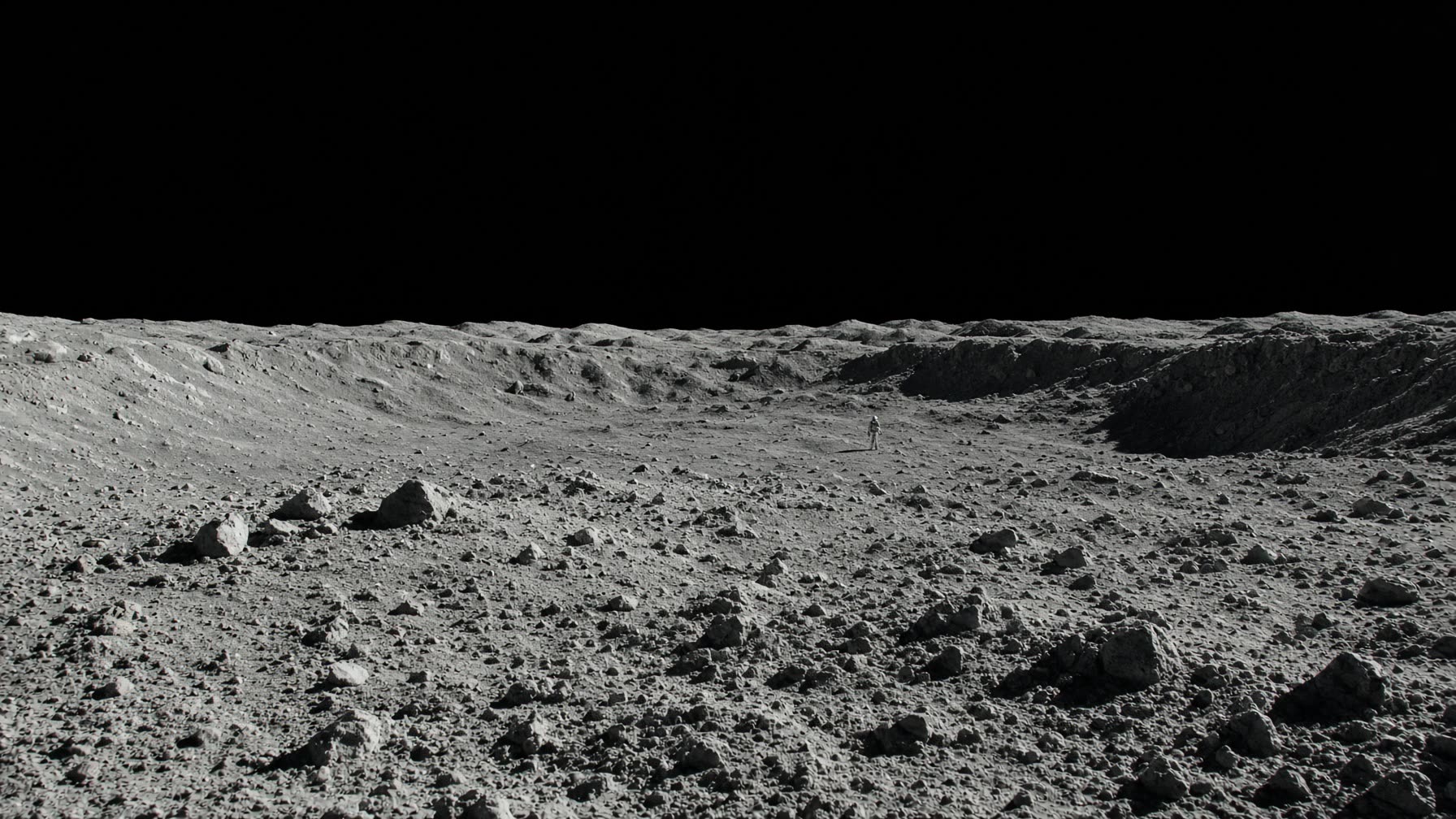
This picture is an artist concept, not a photograph.
Words Eve reads
The Moon. No air. Black sky in daytime. You bounce. Could people live there? People have already walked there. Staying would mean a sealed home, power through a two-week night, and shielding from radiation. Could life exist there? No known life. The surface is a vacuum baked and frozen by turns.
First look
No air. Black sky in daytime. You bounce.
Could people live there?
People have already walked there. Staying would mean a sealed home, power through a two-week night, and shielding from radiation.
We have seen this.
Could life exist there?
No known life. The surface is a vacuum baked and frozen by turns.
This is the present scientific picture.
Where
The nearest world that is not ours.
Look closer
Gravity is about 17 percent of Earth's. The Moon has a very thin exosphere, not weather. Polar craters that never see the Sun can hold water ice.
How we know
People walked there. We have rocks, photographs, and footprints.
The nearest world that is not ours.
About 384,400 km. Light takes about 1.3 seconds.
We measured this.
A bounce instead of a walk.
About 0.17 g
We measured this.
None you can breathe. None you can stand in.
Vacuum. An exosphere, not an atmosphere.
We measured this.
Boiling noon, frozen night.
About 127 C in sun, about -173 C in darkness.
NASA Moon facts. Polar craters can be colder still.
We measured this.
Noon to noon is about a month of Earth days.
About 29.5 Earth days from one lunar noon to the next.
About 13 to 14 Earth days of light, then the same of dark.
We measured this.
Ice in the dark, not rivers in the sun.
Water ice in permanently shadowed polar craters.
We measured this.
No thick air. No global magnetic umbrella.
The surface is exposed.
We measured this.
What this world gives
Nearness, polar ice in permanent shadow, sunlight, metals, and a sky with no air to blur the stars.
What is missing
Air, liquid water on the surface, a magnetic shield, a short night, and Earth gravity.
What could we build?
If a body cannot live in the open, a habitat is the next question. Engineering can try to rebuild pieces of Earth. Gravity, distance, and a world's own chemistry still remain.
Keep looking
Nearness is the gift. Light-time is about 1.3 seconds. That is conversation, not a letter. The hard remainders are night, vacuum, radiation, and dust.
The lunar day is about 29.5 Earth days from one noon to the next. About two weeks of light, then two weeks of dark. Heat swings from about 127 C to about -173 C.
What we do not know yet. How a growing human body handles one-sixth gravity for years is still an open medical question.
A way back into the real
Find the Moon tonight if it is up. It is the same world in this picture, only farther from your feet.
Sources dated 2026-08. Science changes. We date it.
Other worlds as tests
Same question. Different air. The pictures are photographs of worlds. Size lives in the story, not as a bar on the picture.